
Faculty and Visiting Faculty
eskor david johnson
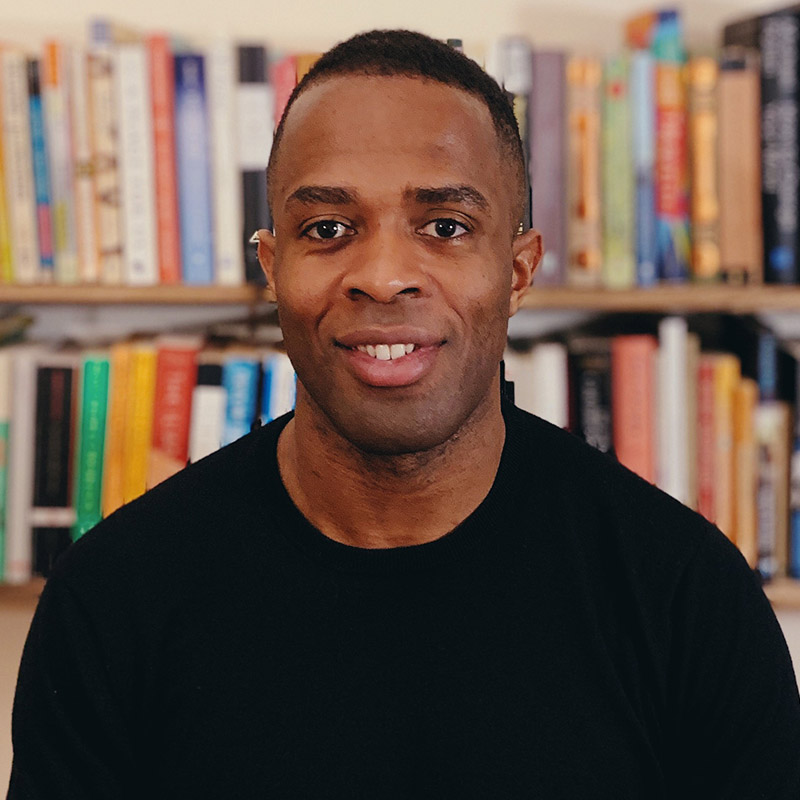
Assistant Professor, Creative Writing
Eskor David Johnson is the author of Pay As You Go, an NPR Best Book of the Year (2023),
a finalist for the Center For Fiction's First Novel Prize as well as the New York
Public Library's Young Lions Fiction award. His writing has appeared in McSweeney's
Quarterly Concern, Guernica, the LA Review of Books, and The Believer Magazine, amongst
others. A graduate of Harvard University (BA 2011) and the Iowa Writers' Workshop
(MFA 2016), he is originally from Trinidad and Tobago.
FACULTY INTERVIEW:
What genre(s) do you write in?
I write in fiction. My first novel is a mock epic, or maybe a modern epic. That’s the niche I am carving for myself. It tries to take a simple notion of plot, someone trying to find something, in this case an apartment in which to live, and exports it to grander proportions than said subject matter would ordinarily warrant.
What is the thing that excites you about the act of writing?
The tranquility, control, and surprise that I'm able to harness in a space that's entirely my own. I'm able to narrow the scope of my worries to the simple matter of the current problem on the page. It's a distilling of life into, in some sense, simpler components. At the same time, you're hopefully able to ultimately arrive at some wider understanding. I am excited by that sense of safety, that sense of comfort, and I'll be honest, that sense of personal importance.
Do you feel like your work is in conversation with other writers or work? If so,
who/what?
For my first book: Patrick Chamoiseau, Salman Rushdie, Avram Mutis, Renata Adler, J.D. Salinger, Ralph Ellison, Gabriel Garcia-Marquez, Italo Calvino. A lot of these writers have larger-than-life novels that went for the more-is-more approach, which I very much believe in.
For what I'm writing right now, I'm actually thinking a lot more about Rachel Cusk, Kazua Ishiguro, and Teju Cole.
What literary magazine would you recommend to your students?
The New Yorker. I think, particularly for students, it gives you a good taste of what contemporary reading culture is like right now. They don't get as much credit as I think they should for the range of short stories that appear. People can quite lazily say that there's a New Yorker-style short story, which maybe had more truth to it at one point in time, but I don't think that that is true now. Within that range, there's a certain bar underneath which the quality of the prose will never fall. That's just good for consistency and it's also just an enjoyable magazine to read. What else do you need out of a weekly magazine?
What is your writing process?
At my best, I wake up as early as I can. Around 9 or 10 PM, I put my phone on airplane mode to wind down and tune my brain away from the internet chatter. I wake up at 5:30 AM and somewhere in those first 45 minutes are the coffee, shower, just getting settled. I have these closed blackout curtains, which helps create this notion of my own private universe. I sit down by 6:30 and start things from there. Around 9:30 or 10 AM is when I turn my phone back on and open the curtains and go back to being alive.
How do you generate ideas?
If you are already honed in on a project, then it becomes a framework through which you yourself are then viewing the world. Your interactions, the things you observe, the comments someone would make, the song that you might hear. You're already much more attuned to be able to fit it into pieces and places in your template.
The process before that, where you don't yet have enough of that scaffolding in place, is a much more abstract space. I often start with a big question that I am personally curious about and already spending my time wondering about. Then, I write to find out what I actually think.
How do you manage when you get stuck?
I write so slowly that I don’t get stuck. By the time I'm typing a thing down, I'm already aware of what's supposed to be happening pages from now.
Inspiration or perspiration?
Inspiration finds you during your perspiration. It also finds you while you are going on runs.
If you weren't a writer, what job would you have?
I probably would have ended up doing something pretty technical. I don't think it would have been anything in the arts; writing is the only art to which I had any kind of inclination or skill. In high school back in Trinidad, I was the top math student of my class. I'd always been into computers. I would like to think that the combination of those two might have led me in some kind of computer science field?
Do you have a writing tip for emerging writers?
If you can be discouraged, then I think it might mean that writing is not for you. If what you need a lot of is external encouragement, you are perhaps just as susceptible to the words of doubters. This is a long path. You have to be your first reader. You have to be your first audience. You have to be your first cheerleader. You have to have a fair amount of self-delusion before others come to believe in your delusion with you.